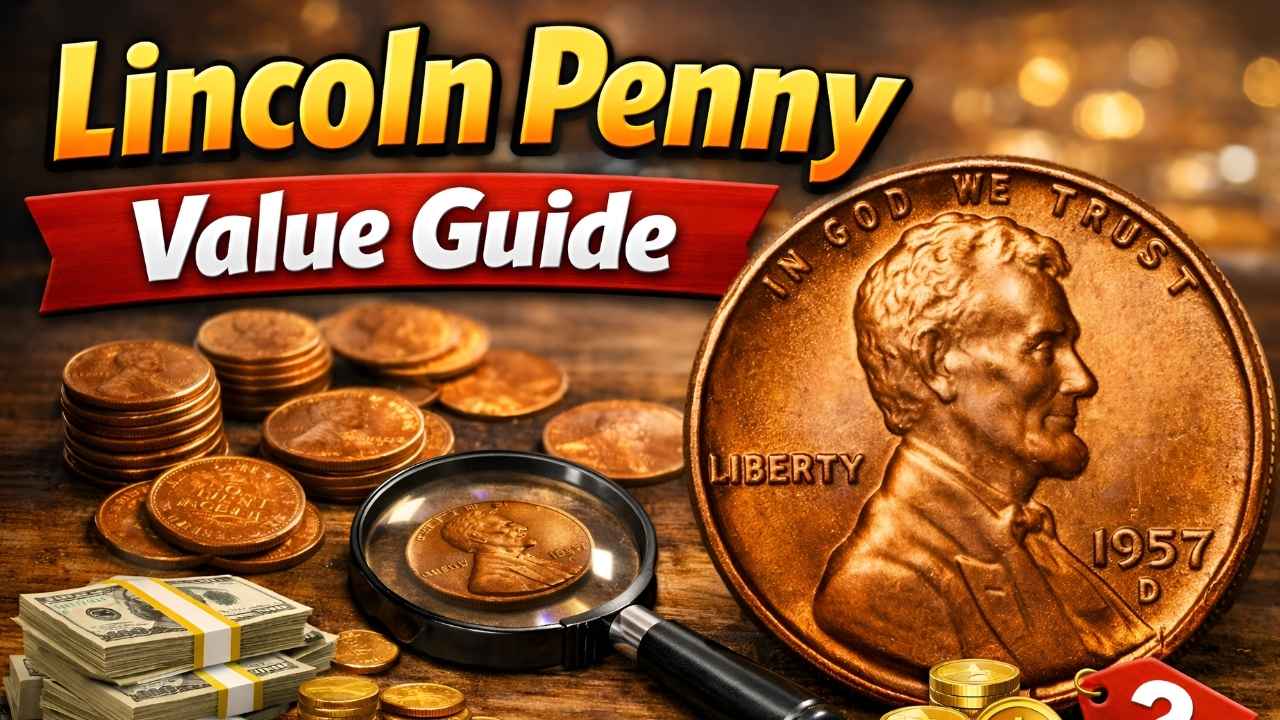
Lincoln Penny Value Guide 2026: The Lincoln penny, first introduced in 1909 to commemorate the centennial of Abraham Lincoln’s birth, remains one of the most collected coins in American numismatics. Designed by Victor David Brenner, the coin has undergone several design changes over the decades, yet it continues to capture the imagination of collectors. In 2026, Lincoln pennies are not only valued for their historical significance but also for their rarity, condition, and unique errors. This guide explores rare dates, notable varieties, and current market prices to help collectors understand the value of these iconic coins.
The 1909-S VDB Lincoln Penny
The 1909-S VDB penny is one of the most famous coins in the series. With a mintage of just 484,000, it is considered a key date coin. The initials VDB, representing the designer Victor David Brenner, were placed prominently on the reverse, leading to controversy and eventual removal. Collectors prize this coin for its rarity and historical importance. In 2026, high-grade examples can sell for thousands of dollars, making it a cornerstone of any Lincoln penny collection.
The 1914-D Lincoln Penny
Another key rarity is the 1914-D penny, struck at the Denver Mint. With a relatively low mintage of just over one million, it is scarce in higher grades. Collectors often seek this coin to complete their early Lincoln sets. Prices vary depending on condition, but uncirculated examples can reach several thousand dollars in today’s market.
The 1922 No D Lincoln Penny
The 1922 penny is unique because all were struck at the Denver Mint, yet some coins were produced without the D mint mark due to worn dies. These “No D” pennies are highly sought after by collectors. In 2026, well-preserved examples remain valuable, often selling for hundreds or thousands depending on grade.
The 1931-S Lincoln Penny
The 1931-S penny is another low mintage coin, with fewer than one million produced. While not as rare as the 1909-S VDB, it is still considered a key date. Collectors appreciate its scarcity, and prices for uncirculated examples continue to rise.
The 1943 Steel Lincoln Penny
During World War II, copper was needed for the war effort, so pennies were struck in steel coated with zinc. These coins are distinctive for their silver-gray appearance. While common in circulated condition, high-grade examples are prized. Additionally, rare error coins struck in bronze during 1943 are among the most valuable Lincoln pennies, sometimes selling for tens of thousands of dollars.
The 1955 Doubled Die Lincoln Penny
One of the most famous error coins in American numismatics is the 1955 doubled die penny. The doubling is most visible in the inscriptions on the obverse, creating a dramatic effect. Collectors cherish this coin for its uniqueness and rarity. In 2026, even circulated examples can command hundreds of dollars, while uncirculated specimens may reach several thousand.
The 1969-S Doubled Die Lincoln Penny
Another notable error is the 1969-S doubled die penny. The doubling is visible in the inscriptions, and the coin is extremely rare. Collectors prize it for its scarcity, and prices remain high, often in the thousands for well-preserved examples.

The 1972 Doubled Die Lincoln Penny
The 1972 doubled die penny is more common than the 1955 or 1969-S varieties, but it is still a popular collectible. The doubling is visible in the inscriptions, and uncirculated examples are particularly valuable. Collectors enjoy the challenge of finding these coins in circulation, though they are increasingly scarce.
The 1982 Small Date Copper Lincoln Penny
In 1982, the composition of pennies changed from copper to copper-plated zinc. During this transition, both large date and small date varieties were produced in copper and zinc. The small date copper penny is especially rare and valuable. Collectors prize it for its uniqueness, and prices remain strong in 2026.
The 1992 Close AM Lincoln Penny
The 1992 close AM penny is a modern rarity. Most pennies from that year feature a wide spacing between the A and M in “AMERICA,” but a small number were struck with the close AM design intended for proof coins. These coins are scarce and valuable, often selling for hundreds or more depending on condition.
The 1999 Wide AM Lincoln Penny
Similar to the 1992 variety, the 1999 wide AM penny is another modern rarity. Most pennies from that year feature the close AM design, but a few were struck with the wide AM design. Collectors prize these coins for their unusual nature, and they remain valuable in 2026.

Factors That Influence Value
The value of Lincoln pennies depends on several factors. Rarity is the most obvious, with low mintage coins and rare varieties commanding higher prices. Condition is equally important, as coins in mint state or proof condition are far more valuable than worn examples. Historical significance also plays a role, with coins tied to important events or transitions in American history often fetching higher premiums. Errors and varieties add another layer of interest, as collectors enjoy the uniqueness of these pieces.
Grading and Authentication
Professional grading services play a crucial role in determining the value of Lincoln pennies. Coins are graded on a scale from 1 to 70, with higher numbers indicating better preservation. Authentication is also important, especially for rare varieties and errors, as counterfeits exist in the marketplace. Collectors often submit their coins to grading services to ensure authenticity and maximize value.
Market Trends in 2026
In 2026, Lincoln pennies continue to be among the most popular coins for collectors. Market trends show steady demand for key date coins, rare varieties, and high-grade examples. While common circulated coins hold little more than face value, rare and pristine pieces continue to appreciate. The enduring popularity of Lincoln pennies ensures that they remain a strong segment of the numismatic market.
Collecting Strategies
Collectors approach Lincoln pennies in different ways. Some aim to acquire every year and mint mark, building complete sets. Others focus on key date coins or rare varieties. Error collectors seek out doubled dies, missing mint marks, and other unusual pieces. Beginners often start with affordable uncirculated examples, while advanced collectors pursue top-graded rarities. Regardless of strategy, Lincoln pennies offer accessible entry points and exciting challenges for collectors at all levels.
Investment Potential
Beyond the enjoyment of collecting, Lincoln pennies offer investment potential. Coins with proven rarity and historical importance tend to hold their value over time. In some cases, they appreciate significantly, providing returns for collectors who view their coins as both treasures and assets. However, like any investment, coin collecting carries risks, and values can fluctuate based on market demand.
Conclusion
Lincoln pennies remain one of the most beloved series in American coinage. From the early rarities of 1909 to modern varieties like the close AM and wide AM pennies, these coins capture the imagination of collectors and investors alike. In 2026, rare dates, errors, and high-grade examples represent some of the most valuable and interesting pieces in the series. Whether pursued for historical appreciation, collecting passion, or investment potential, Lincoln pennies continue to shine as enduring symbols of American history and numismatic artistry.
This value guide highlights the depth and richness of the Lincoln penny series. For collectors, each coin tells a story, and together they form a tapestry of American heritage preserved in copper and zinc. As the hobby grows and evolves, these coins will remain at the heart of numismatic pursuits, inspiring new generations to discover the value of rare Lincoln pennies.